
#P16459. [UOI 2026] Tree Subsets
-
ID: 16440
Type: RemoteJudge
2000ms
512MiB
Tried: 0
Accepted: 0
Difficulty: (None)
Uploaded By:
 Hydro
Tags>
Hydro
Tags> [UOI 2026] Tree Subsets
题目描述
You are given a rooted tree with vertices. The root of the tree is vertex .
Each vertex has a value , which is either or .
For each size (), determine which xor values can be obtained by choosing a set of vertices that satisfies the following conditions:
- ;
- if vertex belongs to the set , then all vertices in the subtree of vertex also belong to .
The value of a set is defined as the xor of the values of all vertices in this set:
The subtree of vertex is the set of all vertices such that vertex lies on the simple path from the root to vertex .
The xor operation for bits is defined as follows: $0 \oplus 0 = 0, 0 \oplus 1 = 1, 1 \oplus 0 = 1, 1 \oplus 1 = 0.$
The child of vertex is a vertex whose parent is .
输入格式
The first line contains one integer () --- the number of test cases.
Each test case consists of three lines.
The first line of each test case contains one integer () --- the number of vertices in the tree.
The second line contains integers () --- the values of the vertices.
The third line contains integers (), where is the parent of vertex .
It is guaranteed that the sum of over all test cases does not exceed .
输出格式
For each test case, output one line with integers .
For each :
- , if among all valid sets of size only xor can be obtained;
- , if among all valid sets of size only xor can be obtained;
- , if among all valid sets of size both xor and xor can be obtained.
2
5
1 0 1 1 0
1 2 1 4
9
0 0 0 1 1 1 1 1 1
1 2 3 2 4 4 6 8
2 1 2 0 1
1 0 1 0 1 2 0 0 0
提示
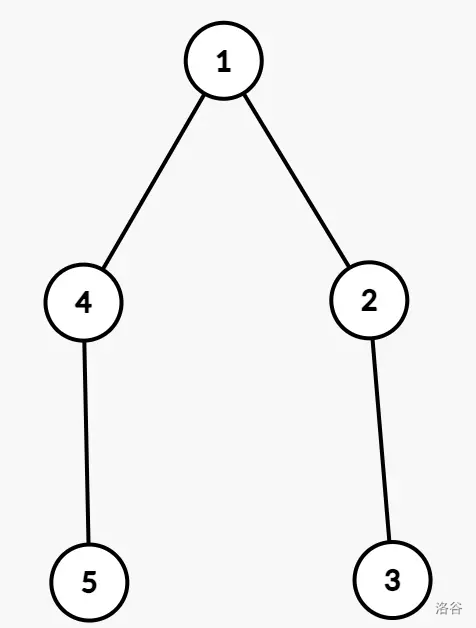
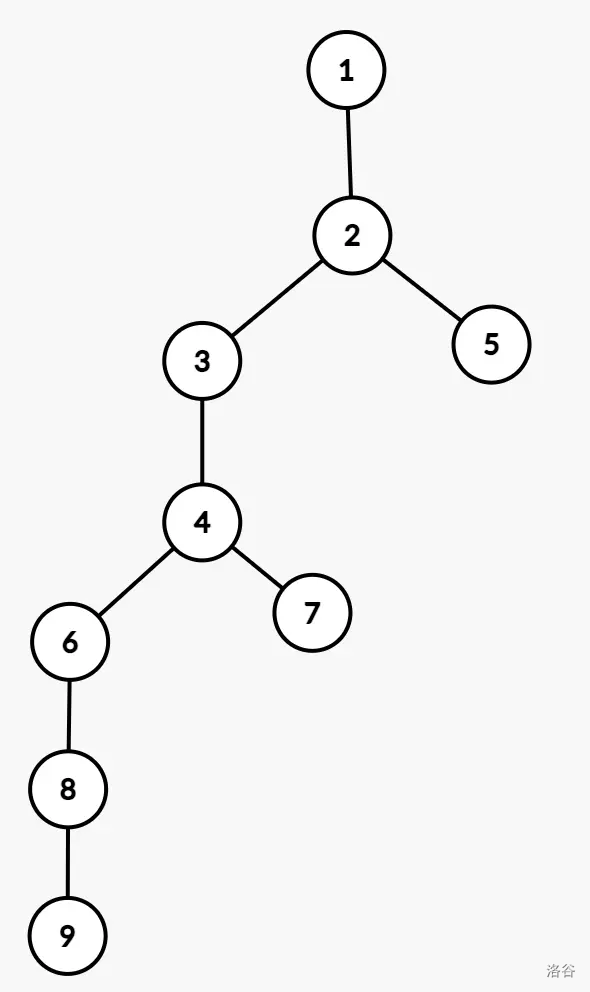
This is what the trees in the first and second test cases look like, respectively.
:::align{center}
 :::
:::
Consider the first test case.
For , both xor values can be obtained. For example, the set is valid and has xor . And the set is also valid and has xor . Therefore, .
For , both xor values can also be obtained. For example, the set is valid because together with vertex all vertices in its subtree are chosen. Its xor is $a_2 \oplus a_3 \oplus a_5 = 0 \oplus 1 \oplus 0 = 1$. And the set is also valid because together with vertex all vertices in its subtree are chosen. Its xor is $a_3 \oplus a_4 \oplus a_5 = 1 \oplus 1 \oplus 0 = 0$. Therefore, .
Thus, the answer for the first test case is .
Consider the second test case.
In this test case, both xor values can be obtained only for .
For example, the set is valid. Its xor is $a_3 \oplus a_4 \oplus a_6 \oplus a_7 \oplus a_8 \oplus a_9 = 0 \oplus 1 \oplus 1 \oplus 1 \oplus 1 \oplus 1 = 1$.
And the set is also valid. Its xor is $a_4 \oplus a_5 \oplus a_6 \oplus a_7 \oplus a_8 \oplus a_9 = 1 \oplus 1 \oplus 1 \oplus 1 \oplus 1 \oplus 1 = 0$. Therefore, .
Thus, the answer for the second test case is .
Scoring
A leaf is a vertex that has no children.
A bamboo is a tree in which every vertex has at most one child.
- ( points): ;
- ( points): ;
- ( points): ;
- ( points): ;
- ( points): the total number of leaves over all test cases does not exceed ;
- ( points): after removing vertex , each component is a bamboo, and there are at most two such components;
- ( points): after removing vertex , each component is a bamboo;
- ( points): all trees are full binary trees, that is, for some integer , and for every vertex we have ;
- ( points): for each test case;
- ( points): no additional constraints.